


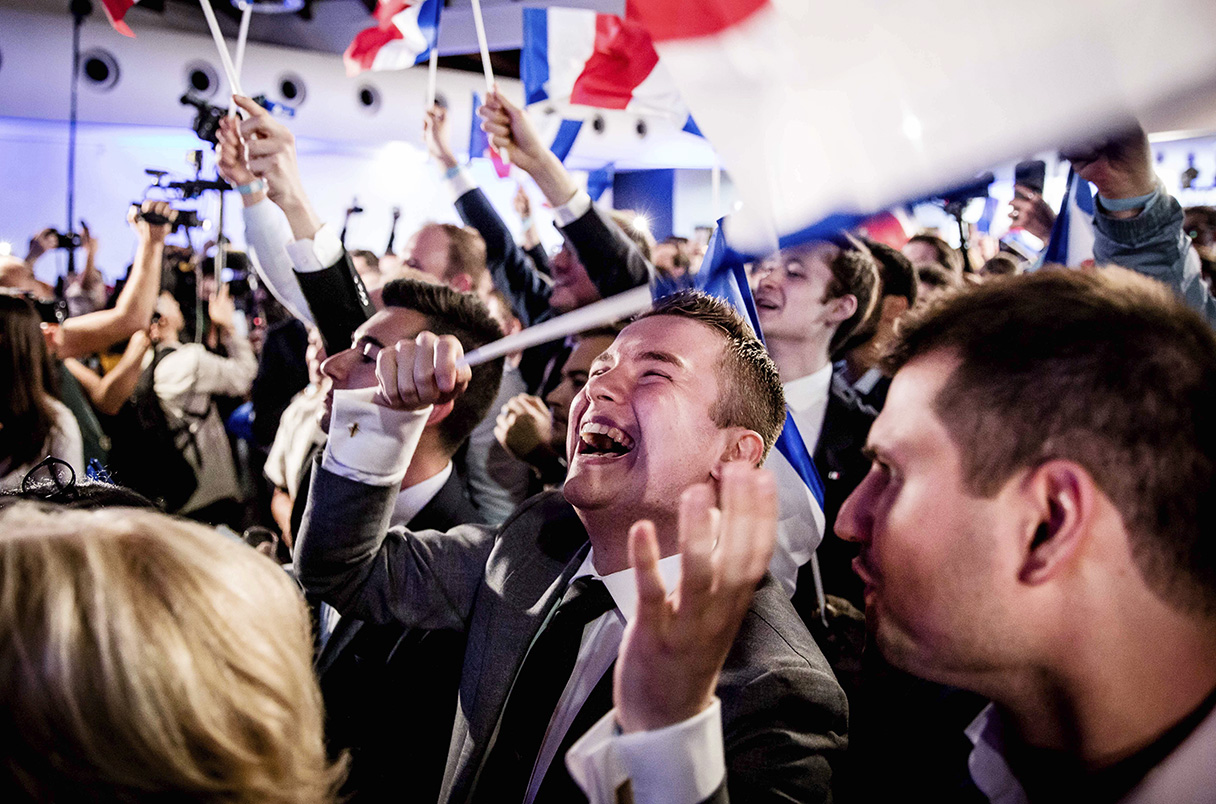
Europe’s citizens pulled the European Parliament further to the far-right in last week’s elections across the continent, concerning researchers who fear the European Union’s science funding and environmental policies could suffer under the influence of nationalist parties.
But science policy experts are breathing a cautious sigh of relief that the far-right’s gains were not as extreme as some polls had predicted.
“It could have been much worse,” says Kurt Deketelaere, secretary-general of the League of European Research Universities. The three main pro-European political groups still hold a “comfortable majority” in the European Parliament and “all three have a positive attitude vis-à-vis research, innovation, and education,” he tells ScienceInsider.
As of today, these three groups—the conservative European People’s Party (EPP), the Progressive Alliance of Socialists and Democrats, and Renew’s Europe’s centrist liberals—have secured an estimated 400 combined seats out of 720. (The exact numbers for each political group in the Parliament will be confirmed in the coming weeks.)
Nationalist and far-right parties are still in the minority overall, but they have gained ground in Austria, the Netherlands, Spain, and especially in France and Germany, the two most populous countries in the EU. The anti-immigration National Rally party came first in France with 31% of votes—more than double that of President Emmanuel Macron’s party—raising its number of members of the European Parliament from 18 to an estimated 30. (In response, Macron called a snap general election for 30 June.) In Germany, Alternative for Germany came in second with almost 16% of votes, and is estimated to go from eight to 16 seats in the European Parliament.
Despite these gains, the Parliament’s landscape has remained “fairly stable” on the whole, says Thomas Jørgensen, the European University Association’s director of policy coordination and foresight. But he warns the far-right’s gains may result in tighter spending and more strings attached to EU science funding, as well as a “politicization of research policies.”
Jørgensen says the “big battle” will be the budget for the next 7-year pan-European science funding program. The current program, the €95.5 billion Horizon Europe, runs until 2027, but the incoming Parliament will negotiate the next period, between 2028 and 2034. “We might see that centralized program coming under pressure from parties that don’t want to spend so much directly from Brussels,” he says.
Environmental policies are also expected to take a hit following the rightward shift, coupled with the Greens losing a predicted 18 seats. “Among the far-right, there are climate change deniers and people who are unhappy with what science shows,” Jørgensen says. This is not a distant threat: Scientists have been raising the alarm for months about the EU’s backpedaling on green reforms. “According to the best of science, these decisions are poorly justified and jeopardise our common future—including the future of the farmers they claim to aid,” says a recent open letter from 20 science associations in Europe.
“It would be irresponsible and tragic if EU policymakers interpreted the election results as a green light to kill the Green Deal,” says Guy Pe’er, a conservation biologist at the German Centre for Integrative Biodiversity Research and the UFZ-Helmholtz Centre for Environmental Research, referring to a giant policy program that aims to make the EU a “climate-neutral continent” by 2050. Pe’er worries the new Parliament could double down on what he sees as a misguided focus on short-term techno-solutions for issues such as climate change, biodiversity loss, land degradation, and pollution.
The election’s impact on the EU’s other institutions—the European Commission, which proposes legislation, and the Council, which codecides on legislation with the Parliament—will become clear in the coming weeks, a period of intense horse trading to fill the top EU jobs. The commission president post typically goes to the winning political group—the EPP—and is currently held by Ursula von der Leyen, from Germany. National governments in each of the EU’s 27 countries will nominate one person to become European commissioner; one of these nominees will succeed research and innovation commissioner Iliana Ivanova from Bulgaria.
The far-right parties’ growth in a number of EU member states means commissioners could be put forward from these parties, “just like prime ministers from those parties can surface in the European Council,” Deketelaere says. “And if that is the case … the EU’s research and innovation agenda can shift,” he says. “Vigilance remains key.”