


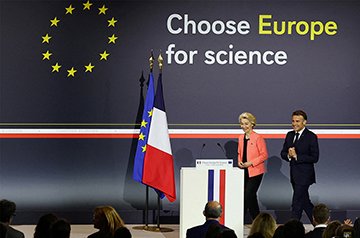
Europe is getting serious about its attempts to lure U.S. researchers who have lost their jobs or want to leave the country because of the assault on research by President Donald Trump’s administration. At a conference at the Sorbonne in Paris today, European Commission President Ursula von der Leyen launched a new campaign, Choose Europe for Science, and said the European Union would budget €500 million in new money in the years 2025–27 “to make Europe a magnet for researchers.”
French President Emmanuel Macron said France would separately spend €100 million out of its €54 billion France 2030 investment plan to attract foreign talent. The government plans to enlist the private sector and local authorities to contribute as well.
“Unfortunately … the role of science in today’s world is questioned. The investment in fundamental, free, and open research is questioned,” von der Leyen said, without naming the United States specifically. “What a gigantic miscalculation.” In contrast, she said, Europe is “choosing to place research and innovation, science and technology at the heart of our economy.”
The leaders did not give a breakdown of how the cash would be spent. But they suggested they would put a priority on supporting research in a number of fields, including health, artificial intelligence, space, climate, energy, quantum technology, semiconductors, biodiversity, disinformation, and promoting an eco-friendly “circular economy.”
Von der Leyen also said she wanted to create a new, 7-year “supergrant” from the European Research Council (ERC) that would go to “the very best” researchers, enabling them to take a long-term perspective. She noted that, through 2027, ERC is doubling, from €1 million to €2 million, the value of grants that cover the cost of relocating to Europe and setting up a new lab.
In France, the online Choose France for Science platform has attracted 30,000 visitors from 157 countries since its launch in mid-April, Macron’s office said today. Of those, 34% were from the U.S. Several hundred scientists have already filed applications to continue their careers in France.
Although European funding can’t replace the billions that have vanished from U.S. research budgets—along with thousands of jobs—some scientists welcomed Europe’s gesture. Six hundred million Euros is “not enormous, but not negligible either,” says immunologist Alain Fischer, a former president of the French Academy of Sciences. “I hope other countries will follow the example,” he says.
Fischer also welcomed the politicians’ strong commitment to scientific freedom and the value of knowledge. “These can’t be stressed too much,” he says. At the conference, von der Leyen said the EU would “enshrine scientific freedom” in a new EU law, “Because as threats rise across the world, Europe will not compromise on its principles. Europe must remain the home of academic and scientific freedom.”
Both politicians acknowledged that the European research system has its weaknesses, including excessive bureaucracy and a lag in translating basic research to commercial applications. The U.S. model has been far much more efficient than its European counterpart over the past 30 years, Macron said.
Fischer notes that Macron himself promised 18 months ago to streamline procedures for French researchers, but says, “almost nothing has happened since then.” Indeed, there are major obstacles to making European research “as nimble and agile” as it is in North America, says Mona Nemer, chief science adviser to the Canadian government. “Europe should adopt a holistic approach to the scientific ecosystem,” she says, and realize that “attracting talent without investing enough in infrastructure is not going to work.”
At today’s meeting, David Paltiel, a public health and management researcher at Yale University, said he hoped Europe’s defense of science would nudge timid U.S. university presidents to speak out against the Trump administration, instead of engaging in what he called “the silent acquiescence that teaches the autocrats what they can get away with.”