


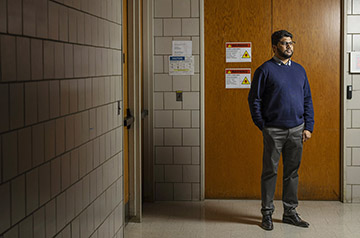
Ranga Dias, a physicist at the University of Rochester, known for his contentious claims of achieving room-temperature superconductivity under extreme pressures, has silently filed a patent that could revolutionize the field. In an unnoticed move, Dias asserts the creation of a material that not only superconducts at room temperature but also at ambient pressure.
If proven true, this discovery could have profound implications, opening avenues for applications like lossless electrical transmission lines, highly efficient computer chips, and cost-effective levitating trains. Eva Zurek, a superconductivity theorist at the University at Buffalo, acknowledges the potential impact, stating, "We cannot even imagine how impactful it would be."
However, skepticism looms large, especially from scientists critical of Dias's previous claims. James Hamlin, a superconductivity researcher at the University of Florida, expresses doubt, suggesting that reported superconducting behavior in the patent could be attributed to issues with electrical contacts in the material characterization devices.
Dias's track record has faced scrutiny, with a 2020 report on a mix of carbon, sulfur, and hydrogen being retracted due to measurement discrepancies. Despite persistent criticism, Dias continued his pursuit, presenting another report in March on lutetium, nitrogen, and hydrogen superconducting at 294 K under significant pressure.
The recent patent filing claims an ambient pressure, room-temperature superconductor within a different form of lutetium, nitrogen, and hydrogen, without providing precise conditions or atomic structures. Critics like Hamlin express concern about similarities between the patent's experimental measurements and those in the March Nature paper.
Independent replication efforts by Russell Hemley at the University of Illinois Chicago show promising results, aligning with some of Dias's claims. However, other research groups attempting to replicate Dias's methods have not observed signs of superconductivity.
If the patent's assertions are upheld, it could simplify electrical and magnetic measurements, potentially eliminating the need for a diamond anvil cell. Theoretical studies by Hemley's team propose that the unique electronic behavior of the lutetium, nitrogen, and hydrogen structure may allow superconductivity at near-ambient conditions, challenging conventional theories.
The patent, filed in July 2022, is pending adjudication, with a typical review duration of around two years. Dias's pursuit of room-temperature superconductors has already led to the founding of Unearthly Materials in 2020, aiming to commercialize these groundbreaking materials.
The global market for superconducting materials, currently valued at $1.1 billion, stands to undergo significant transformations if Dias's claims are substantiated, ushering in a new era of ambient superconductivity.