


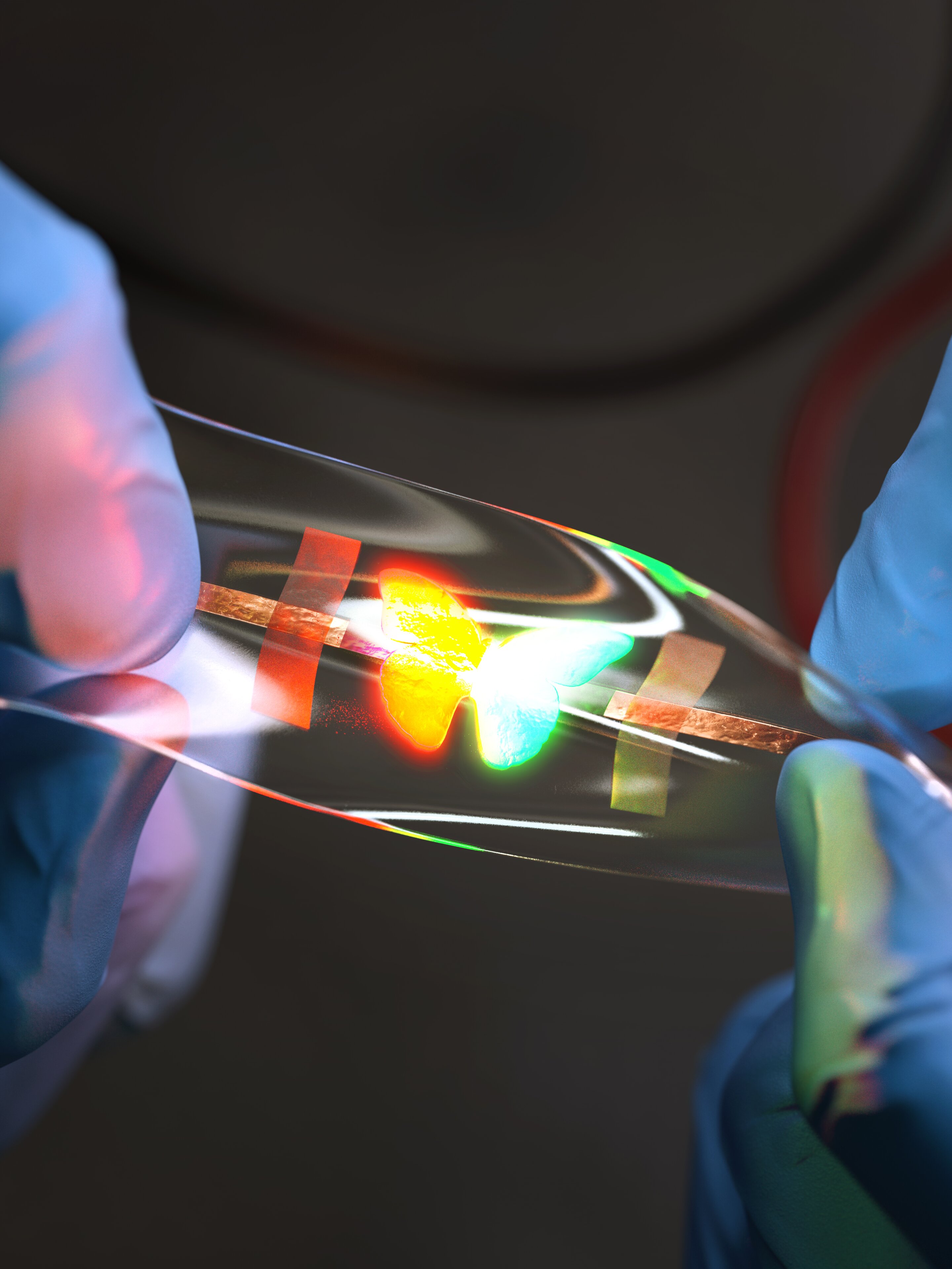
In a significant advancement in display technology, a team of South Korean scientists, led by Professor KIM Dae-Hyeong from the Center for Nanoparticle Research at the Institute for Basic Science, has unveiled a groundbreaking approach to stretchable displays. Their pioneering work marks the first successful development of intrinsically stretchable quantum dot light-emitting diodes (QLEDs).
The pursuit of intrinsically stretchable displays has long been a challenge in the dynamic realm of display technologies. Traditional displays, confined by rigid components, have faced limitations in transitioning to flexible formats. This limitation spurred the necessity for innovative materials and device designs capable of enduring substantial stretching while preserving functionality—a crucial requirement for applications ranging from wearable to adaptable interfacing technologies.
Unlike the prevalent organic light-emitting diode (OLED) technology employed in most flexible displays, which presents constraints such as limited brightness and color accuracy, QLED displays offer superior color reproduction, brightness, and durability, making them an attractive choice for consumers.
However, the inherent challenge in developing flexible QLED displays lies in the nature of quantum dots (QDs), which lack intrinsic stretchability as 0-D inorganic nanoparticles. Previous attempts to embed QDs within elastic materials encountered hurdles due to the insulating properties of elastomers, hindering efficient electron and hole injection into the QDs and compromising electroluminescent efficiency.
To address these challenges, the IBS researchers introduced innovations to enhance carrier delivery to the QDs. By incorporating a third material—a p-type semiconducting polymer, TFB—they improved both the stretchability of the device and the efficiency of hole injection. This strategic addition of TFB also optimized the balance between electron and hole injections.
An intriguing aspect of their approach was the ternary nanocomposite film's distinctive internal structure, featuring phase separation. This structural arrangement minimized exciton quenching sites and bolstered hole injection efficiency, resulting in optimized device performance.
Through meticulous material selection and engineering, the researchers achieved QLEDs with exceptional brightness (15,170 cd m-2), surpassing other stretchable LEDs, and a low threshold voltage (3.2 V). Remarkably, the device maintained integrity even under significant stretching.
Furthermore, the researchers developed a high-resolution patterning technology applicable to stretchable quantum dot light-emitting layers, demonstrating the potential for complex applications such as RGB LEDs and passive matrix arrays.
This groundbreaking research not only underscores the superior performance of QDs in stretchable displays but also charts a new trajectory for enhancing device efficiency. Future endeavors will concentrate on optimizing carrier injection efficiency and stretchability across all device layers, laying the groundwork for the next generation of QLED technology. This advancement promises a future where display technologies transcend flexibility to embrace true stretchability, unlocking innovative possibilities in wearable electronics and beyond.
More: https://techxplore.com/news/2024-04-stretchable-quantum-dot-display.html