


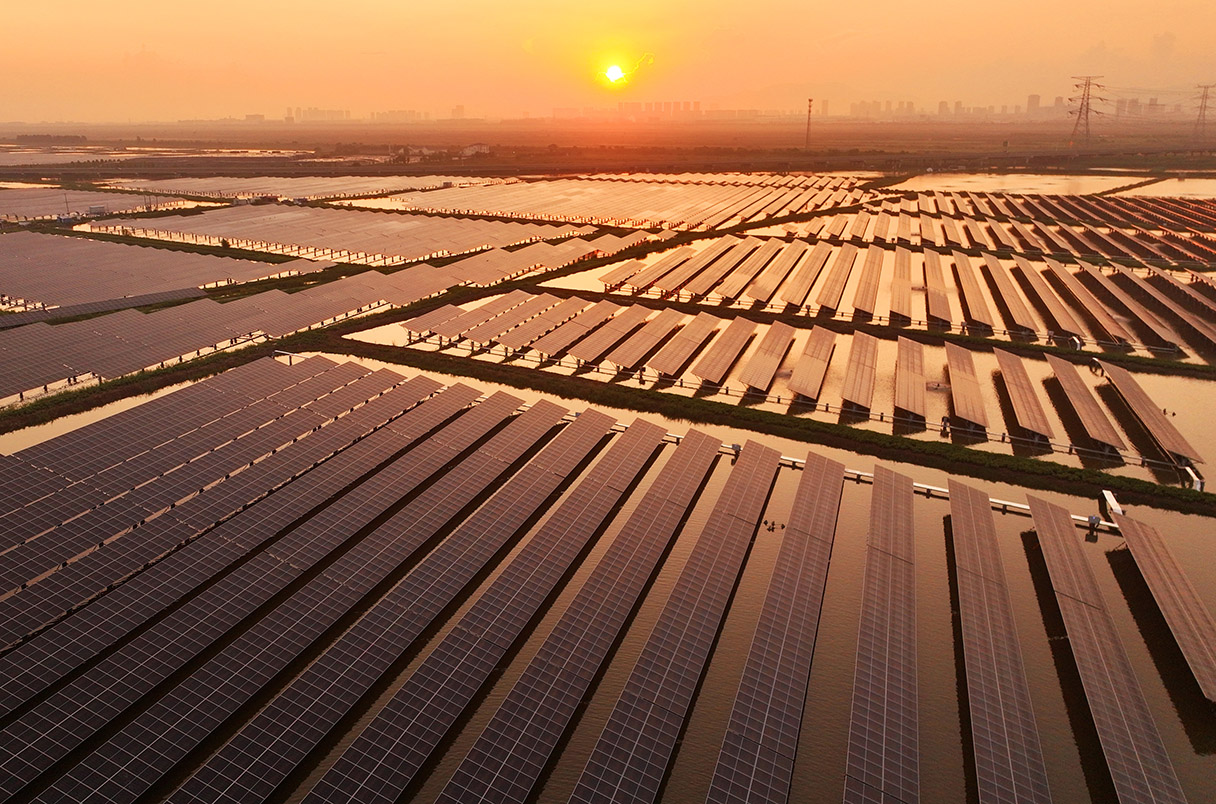
For nearly a year, climate specialists have been speculating that carbon dioxide (CO2) emissions from China—the world’s largest emitter—may have peaked in 2023, well before a government goal to halt emissions growth by 2030. Supporting evidence emerged earlier this month, when a new analysis from the Asia Society Policy Institute showed that China’s increasing reliance on renewable energy had cut CO2 output during the April to June quarter by 1% compared with the same period of 2023.
However, two contradictory trends raise questions about exactly when and at what level China’s emissions might peak—a key issue for global efforts to curb climate change.
On one hand, China now far outpaces the rest of the world in installing new solar and wind capacity, cutting emissions growth. But the country also leads the world in firing up new coal-fueled power plants, a major source of planet-warming CO2.
The competing efforts have created “a lot of uncertainty” in projecting the future of China’s emissions, which now account for 31% of the world’s total, says Glen Peters, an analyst at the Center for International Climate Research in Norway. Further clouding the crystal ball: a mix of economic and political factors, including pressure from Chinese energy companies to keep coal plants producing revenue as long as possible.
Despite those uncertainties, Peters and others still expect China to handily beat the 2030 peaking deadline, which President Xi Jinping set in 2020. That target is in reach because of China’s rapid deployment of renewables. Last year, China commissioned as much new solar power as the entire world brought online in 2022, and its capacity to generate wind energy expanded by two-thirds, according to the International Energy Agency. China currently has 339 gigawatts (GW) of utility-scale solar and wind power under construction, more than the rest of the world combined, according to a July report from the Global Energy Monitor (GEM). And GEM’s total does not include rooftop panels and other small-scale solar installations that made up about 40% of last year’s new solar capacity. (China has also been adding other sources of energy that have low carbon emissions. Over the past 2.5 years, for example, authorities have approved plans to build 31 nuclear reactors.)
The Asia Society’s recent review of China’s overall CO2 output so far this year also noted a 3% drop in March compared with March 2023. Such data suggest the nation is “on track for a decline in annual emissions” this year, Lauri Myllyvirta, an emissions analyst, wrote in an 8 August post on the Carbon Brief website.
But continuing that decline in CO2 production likely hinges on what China does with its new coal-fired power plants, which could remain in service for decades. Last year the nation added 44 GW of coal capacity, accounting for two-thirds of what was brought online worldwide, according to GEM. An additional 140 GW of coal capacity is under construction, and even more is in the planning stage—although authorities may now be putting the brakes on new permits. Only 14 coal-fired power projects with a combined capacity of 10 GW gained approval in the first 6 months of this year, an 80% cut from the level of the first half of 2023, according to a report released on 20 August by Greenpeace East Asia. But Greenpeace’s Gao Yuhe warned in a statement that a rebound in approvals “remains possible until there are firm measures put in place to directly prevent further coal expansion.”
Officially, coal power is supposed to become a backup to renewable energy sources. But Christoph Nedopil, a development economist at Griffith University, expects China’s government to “try to find a balance between renewables and coal” while still meeting its peak emissions goal.
“Coal can’t be given up quickly or easily,” adds GEM analyst Aiqun Yu. In part that’s because energy firms want to operate their new plants enough to earn a return on their investment. The coal sector is also a major employer. Such concerns have left the government “trying to navigate a pathway for coal’s survival in the long term,” Yu says.
In November 2023, for example, the National Energy Administration announced it will pay coal plants a fixed amount based on their capacity—how much electricity they can theoretically produce—regardless of how much they actually generate. In July, the agency unveiled a plan to develop low-carbon coal technologies, including carbon capture and storage, that could give coal a longer future.
Unfortunately for the global climate, a slower phase-out of coal in China will add more CO2 to the atmosphere than if the nation maximizes its use of renewable energy as soon as possible. “What matters for the climate is total cumulative emissions over time,” Myllyvirta says.
Ironically, Yu and other analysts say growing pains for renewables in China have created an opening for continued coal use. The nation’s “coal-centered grid is not well prepared to absorb these massive amounts of rapidly growing renewables,” Yu says. The majority of China’s wind and solar farms are in the sunny and windy western provinces, for example, and it is difficult to move the power they produce to the population and manufacturing centers along its eastern coast. The grid is also not yet optimized to handle the variability of solar and wind power production, and China’s electricity storage capacity is limited. In March, these limitations meant 5% of China’s solar power was curtailed, or not fed into the grid.
New storage facilities and high-capacity transmission lines will eventually resolve the renewable challenges, Yu says. But concerns about the stability and flexibility of renewables led to the current coal plant building spree. “Adding so much coal will certainly lead to overcapacity, revenue loss, and potential asset strands,” Yu says, referring to coal plants and infrastructure that will end up with little value. And such issues could only worsen as China moves to meet another goal set by Xi: achieving carbon neutrality by 2060. That is expected to require China to get 90% of its electrical power from non–fossil fuel energy, up from roughly 40% last year.
Clues to how China might meet that goal could come next year, when the government is scheduled to release an updated plan for reducing emissions under the Paris climate agreement. “We certainly hope China submits a more ambitious plan,” Yu says. “The scenario might be China increasing the target for renewables but not giving up much on coal.”