


Imagine a thin wristband that monitors your steps and heartbeat like an Apple Watch. Or clothing that keeps you cool with built-in air conditioning. Or even a flexible implant that could help your heart better than a bulky pacemaker. That’s the promise of a new, electrically active material researchers have created by combining short chains of amino acids called peptides with snippets of a polymer plastic. This “electric plastic,” reported this month in Nature, can store energy or record information, opening the door to self-powered wearables, real-time neural interfaces, and medical implants that merge with bodies better than current tech.
Most electronic materials are rigid or contain toxic metals, which makes it tough to design devices that conform to the body or that could be embedded within tissues. One of the few soft plastics that can be used in electronic devices is a polymer called polyvinylidene fluoride (PVDF), discovered in the 1940s. It has a polar structure that switches its orientation when stimulated by an external voltage—the chemical equivalent of flipping an electronic bit. However, these “ferroelectric” properties are not stable and disappear at higher temperatures. The plastic also requires high voltages to switch polarities, making it more energy intensive to operate.
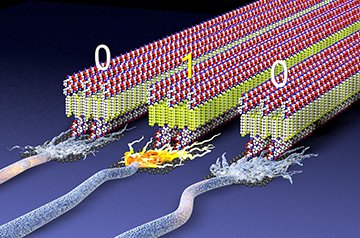
Samuel Stupp, a materials scientist at Northwestern University, and his colleagues thought they could improve on PVDF’s properties. The team connected peptides with small PVDF segments, which naturally assembled into long, flexible ribbons. The molecules then coalesced into bundles and aligned to form an electro-active material. “Remarkably,” Stupp says, “the self-assembly process is triggered by adding water.”
The new material overcomes PVDF’s limitations. It requires 100 times less voltage to switch polarization compared with other ferroelectric materials, making it ideal for low-power applications. And it retains its ferroelectric properties at temperatures of 110°C—about 40°C higher than other PVDF materials.
Stupp’s new material can store energy or information by electrically switching the polarity of each ribbon. And because the peptide on the end of each ribbon can be connected to proteins on neurons or other cells, the molecules can record the signals from the brain, heart, or other organs—or electrically stimulate them. By using low-power techniques like ultrasound to “charge” the molecules, the material could be used to stimulate neurons as a treatment for chronic paralysis, Stupp says.
Study co-author Yang Yang, an electrical power engineer at Northwestern, notes that PVDF is biocompatible, making the material a promising candidate for soft implants that could be wirelessly controlled from outside the body.
Although PVDF is nontoxic, some researchers are wary of its long-term impact in the environment. Fluorinated compounds can persist in the environment for centuries—one reason why Europe has proposed banning PVDF. William Arnold, an environmental engineer at the University of Minnesota, Twin Cities who was not involved in the study, also says microbes could potentially break down the PVDF snippets into trifluoroacetic acid, a contaminant of emerging concern. Moreover, he adds, to prepare the molecular ribbons, Stupp’s team used a per- and polyfluoroalkyl substance molecule—another long-lasting fluorinated compound that has been linked to environmental and human health problems.
So far, Stupps’s team has only conducted small-scale evaluations of the molecules. Scaling up will require depositing the water-suspended structures onto devices without altering them, says Frank Leibfarth, a chemist at the University of North Carolina at Chapel Hill who was not involved in the study. Still, he says, “This advance has enabled a number of attractive properties compared to other organic polymers.”
Despite the challenges, Stupp is confident that the combination of peptides and PVDF is a recipe for success. “This paper has a much broader concept than just vinylidene fluoride,” he says. “There probably are other possibilities … that don’t have fluorine.” He is hopeful that the material represents the beginning of a future where technology doesn’t just act on us, but blends with us.
