


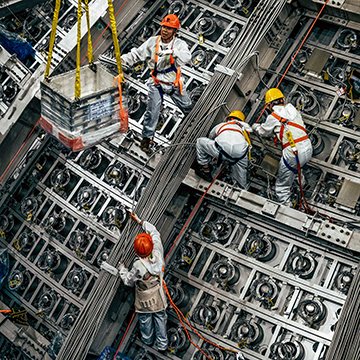
KAIPING, CHINA—Some 700 meters beneath a hill here in the rural hinterlands of Guangdong province, a new observatory is preparing to tackle one of cosmology’s lingering questions: Which of the three “flavors” of the wispy particles known as neutrinos has the greatest mass? The answer could improve our understanding of fundamental physics, astrophysics, and cosmology.
The Jiangmen Underground Neutrino Observatory (JUNO) “is very innovative and timely,” says Jennifer Thomas, a particle physicist at University College London who sits on the observatory’s scientific advisory committee. “It is a very challenging measurement, but if they are successful, it will have huge impact on the field.” Other experiments, in the United States and Japan, are pursuing the same goal, but many physicists think JUNO’s unmatched sensitivity could give it an edge.
Late last month, JUNO researchers gathered here to plan to start taking data a year from now. In blue hard hats and orange vests, some rode a rudimentary cable car down a steeply sloped 1200-meter tunnel to the experiment chamber. There, the researchers clambered up scaffolding into the center of the massive, 35-meter-diameter acrylic sphere at the heart of the detector.
The sphere will soon be filled with 20,000 tons of a liquid scintillator—an organic solution that fluoresces, or scintillates, when excited by a neutrino interacting with nuclei in its atoms. It will be the largest and most sensitive scintillation detector ever built. Scientists improved the transparency and radiopurity of the acrylic used in the sphere and of the liquid scintillator, enabling JUNO to gather more of the telltale light flashes. And industrial partners boosted the sensitivity of the 43,000 photomultiplier tubes arrayed around the sphere that detect the pulses. In a first, smaller tubes sit between larger tubes, enhancing the sensors.
As neutrinos zip along at nearly the speed of light, they have the strange ability to change back and forth among three types or flavors: electron, muon, and tau. JUNO will build on results of an earlier detector, China’s Daya Bay Reactor Neutrino Experiment, which used a tank holding scintillator to catch antineutrinos generated by nuclear reactors. In 2012, its data enabled physicists to determine a key parameter describing how frequently neutrinos change their identities.
Even while Daya Bay was under construction, China’s Institute of High Energy Physics (IHEP) was studying a possible successor. IHEP President Yifang Wang recalls that when Daya Bay made headlines, the head of the Chinese Academy of Sciences (CAS) asked him: “What’s next?” Wang “had a plan in my pocket,” he says.
CAS allotted $300 million to build JUNO. To realize the plan, Wang assembled a collaboration that now numbers about 700 members from 76 institutions in 18 countries. IHEP and Wang “have leveraged their Daya Bay experience in a clever way,” says Patrick Huber, a theoretical physicist at the Virginia Polytechnic Institute and State University.
The result is what Huber calls “a high-impact, modest-risk experiment.” By studying electron antineutrinos coming from eight reactors at two nuclear plants, both 53 kilometers away, the project aims to solve a puzzle known as the mass ordering (also called the mass hierarchy). Neutrinos come in three mass states—m1, m2, and m3—that, confusingly, do not correspond to the three neutrino flavors. Each flavor is a quantum mechanical mix of the three mass states.
Physicists have already determined that m2 is slightly heavier than m1 and that there is a greater mass difference between m3 and the other two. But they don’t know whether m3 is heavier than m2—what’s called the normal ordering—or lighter than m1, the inverted ordering. The order has implications for other key questions in physics, such as how neutrinos acquire mass in the first place.
As the electron antineutrinos travel from the reactors to JUNO, many will oscillate into muon or tau antineutrinos that the detector can’t see. Some of the surviving electron antineutrinos will slam into a proton in the scintillator, producing an energetic positron that results in a flash of light. The collision will also produce a lower energy neutron that, about 200 microseconds later, will be captured by an atomic nucleus and produce a second flash. The rapid one-two flicker “allows us to select our signal” from background noise, says Pedro Ochoa-Ricoux, an experimental physicist at the University of California, Irvine, who is a member of the JUNO team. By comparing the number of electron antineutrinos emanating from the reactors with the number detected, JUNO physicists can determine how many have oscillated into the undetectable muon or tau flavors.
Whether the neutrino mass ordering is normal or inverted subtly affects the neutrino oscillations. JUNO’s unprecedented sensitivity will allow scientists to distinguish whether the energy spectrum—how the neutrinos’ oscillation rate varies with their energy—matches that expected for the normal or the inverted ordering. The difference between the spectra is so minute that researchers will need to record 100,000 events to achieve statistical significance, requiring about 6 years of data.
Groundwater problems delayed JUNO’s start by 3 years, but Wang is confident it will solve the mass ordering question ahead of its rivals. Two ongoing neutrino experiments that study beams of neutrinos from accelerators—NOvA at Fermi National Accelerator Laboratory and Japan’s Tokai to Kamioka (T2K)—“have been slowly chipping away at the mass hierarchy,” Huber says. But he gives JUNO “3-to-1 odds to get there first.”
If it doesn’t succeed, the challenge will pass to two massive planned experiments: Japan’s $800 million Hyper-Kamiokande and the United States’s $3.3 billion Deep Underground Neutrino Experiment. But they won’t start to collect data before 2027 and sometime in the 2030s, respectively.
In the meantime, researchers expect JUNO to help answer other questions. For example, it will capture low energy solar neutrinos, providing “a real time picture of processes at the center of the Sun,” says Barbara Caccianiga, a nuclear and particle physicist at Italy’s National Institute for Nuclear Physics. JUNO could also score the first ever observation of the diffuse supernova neutrino background—the neutrinos emitted by all the giant stars that have collapsed in supernovae across the universe. And in 1 year JUNO will likely capture more geoneutrinos—generated by the radioactive decay of Earth’s thorium and uranium—than have been measured in history. The geoneutrinos could provide clues to the planet’s composition and geophysical processes such as mantle convection.
Meanwhile, “I do have another experiment after JUNO in my pocket,” Wang says. It would tweak JUNO’s liquid scintillator so the detector could watch for another exotic nuclear physics phenomenon called neutrinoless double beta decay. If neutrinoless double beta decay is ever observed it would indicate that the neutrino is its own antiparticle, unlike any other fundamental particle that has mass. The finding that might provide a clue to why there is more matter than antimatter in the universe. Wang aims to launch the follow-on experiment by 2040.
