


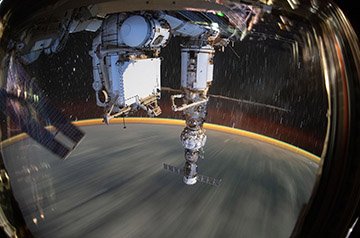
What is the point of the International Space Station (ISS)? For some, the station—by some accounts the most expensive structure ever built—represents a triumph of engineering. It has also hosted astronauts for more than 2 decades straight, showcasing the endurance of international partnerships, even amid wars, and it has provided a destination for space agencies that cannot yet afford to return humans to the Moon. For University of Florida biologist Rob Ferl, however, the ISS is a one-of-a-kind laboratory—one that is just beginning to be utilized well.
Since the station’s first components were launched in 1998, researchers have conducted more than 3000 experiments there to understand how the topsy-turvy environment of space affects everything from protein crystallization to combustion. But with access to space getting cheaper, and with commercial replacements to the ISS on the horizon, Ferl hopes the number of studies will rise dramatically. He was among 75 scientists who today called for NASA’s funding of biological and physical science on the ISS and elsewhere to expand by a factor of 10, to deliver both basic research and science that could advance the agency’s human space exploration goals.
“There is an absolutely huge movement into space, for which we need a huge amount of science,” says Ferl, who co-chaired the panel, which was overseen by the National Academies of Sciences, Engineering, and Medicine. The resulting “decadal survey,” the first on research in space since 2011, gives priorities to NASA and Congress on how the ISS and future space stations should be used.
The report finds that NASA’s Division of Biological & Physical Sciences (BPS), which now oversees much of this work, is “severely underfunded” relative to the prominent role that it is expected to play in the agency’s space exploration efforts. BPS currently receives $85 million per year, less than 3% of the $3.2 billion allocated to NASA’s planetary science division. To support the needed base of scientific researchers, the panel estimates that BPS will need roughly $1 billion a year before the decade’s end.
The report coincides with a sea change in human spaceflight capabilities. NASA’s Artemis program promises to return humans to the Moon on the way to Mars. Rocket companies have lowered the cost of getting people and hardware into low-Earth orbit. And NASA is encouraging private interests to use its portion of the ISS for commercial research and tourism until it is retired in 2030 and manage the station’s successors. In 2021, NASA awarded more than $415 million to three companies to develop concepts for commercial space stations that NASA astronauts would visit alongside other tenants, including private researchers and space tourists.
“We were actively waiting for this decadal survey because [its priorities] will drive a lot of the hardware that’s put onboard these commercial space stations,” says David Marsh, director of space station strategy for Voyager Space, one of the three companies developing station concepts.
Space stations provide uniquely long-duration conditions for testing the effect of microgravity—the apparent weightlessness that comes with free falling in orbit. Some researchers have worked to tease out precisely how plants respond to mechanical strain when they cannot sense gravity, for example, whereas others have investigated the behavior of fluids when surface tension dominates. “There are a lot of things that are obscured by gravity,” says decadal member Debjyoti Banerjee, a mechanical engineer at Texas A&M University.
And gravity itself is worth investigating. The panel sketches out a major multiagency initiative that would send atomic and optical clocks on future space missions, possibly including the Uranus orbiter recommended by the 2022 decadal survey for planetary science. When synchronized, this network could test theories of gravity by measuring spacetime’s curvature across the Solar System, with up to 100,000 times the sensitivity of Earth-based experiments.
NASA’s BPS division doesn’t just focus on fundamental science, however: Its mission is also to enable human space exploration. To address this second prong, the survey calls for focusing much of the increased spending on two ambitious ground- and space-based research campaigns, each costing between $100 million and $400 million per year—on the scale of NASA spacecraft missions.
One would gather the fundamental science needed to build life-based systems that could keep crews alive in deep space for years at a time. For example, the report proposes studying how spacecraft bioreactors could harness algae, bacteria, and fungi to produce precursor compounds for medicines and bioplastics.
The other would supercharge research into zero-waste recycling methods and the techniques needed to “live off the land” on the Moon and elsewhere. Among other things, the report suggests studying how 3D-printed objects could be made from raw planetary materials such as lunar soil and how the products could be recycled back into feedstocks again and again.
The panel also recommends that NASA examine refitting a retired ISS crew capsule, such as one of SpaceX’s Crew Dragon vehicles, with habitats for dozens of rats. These “rat-stronauts” would then be launched on a 90-day mission to orbit over Earth’s poles, where Earth’s magnetic field is weak and provides little shielding from solar and cosmic radiation. The mission would let researchers study how a large, genetically diverse population of mammals contends with microgravity and high radiation at the same time: conditions resembling what future crews would face on the way to Mars.
The survey calls not just for more research in space, but also for it to be conducted at a faster pace. Until recently, launching experiments to the ISS often took years of planning, and almost as long to get samples back to Earth. Many ISS experiments ended up being “one and done,” with few opportunities for replication and follow-up work. “It’s really been set up for failure, in my opinion, the way science has been done on the space station,” says Olivia Gamez Holzhaus, founder and CEO of the firm Rhodium Scientific, which helps researchers design and execute biotechnology experiments on the ISS.
But the growing cargo capacity of rockets and their increasing pace of launch is making it easier to do science quickly. NASA’s BPS division is also seeking enough funding to send scientists into space to conduct research themselves. “We need to do experiments faster in space,” NASA BPS Director Lisa Carnell wrote in an email to Science. “We can’t have a holding pattern where it takes 10 years to fully complete and understand an experiment.”
Decadal Co-Chair Krystyn Van Vliet, vice president for research and innovation at Cornell University, wants this accelerated pace to carry beyond the ISS to the commercial stations that succeed it. “The next decade is going to be full of discovery and transformation,” she says. “But now we have to seize it.”
