


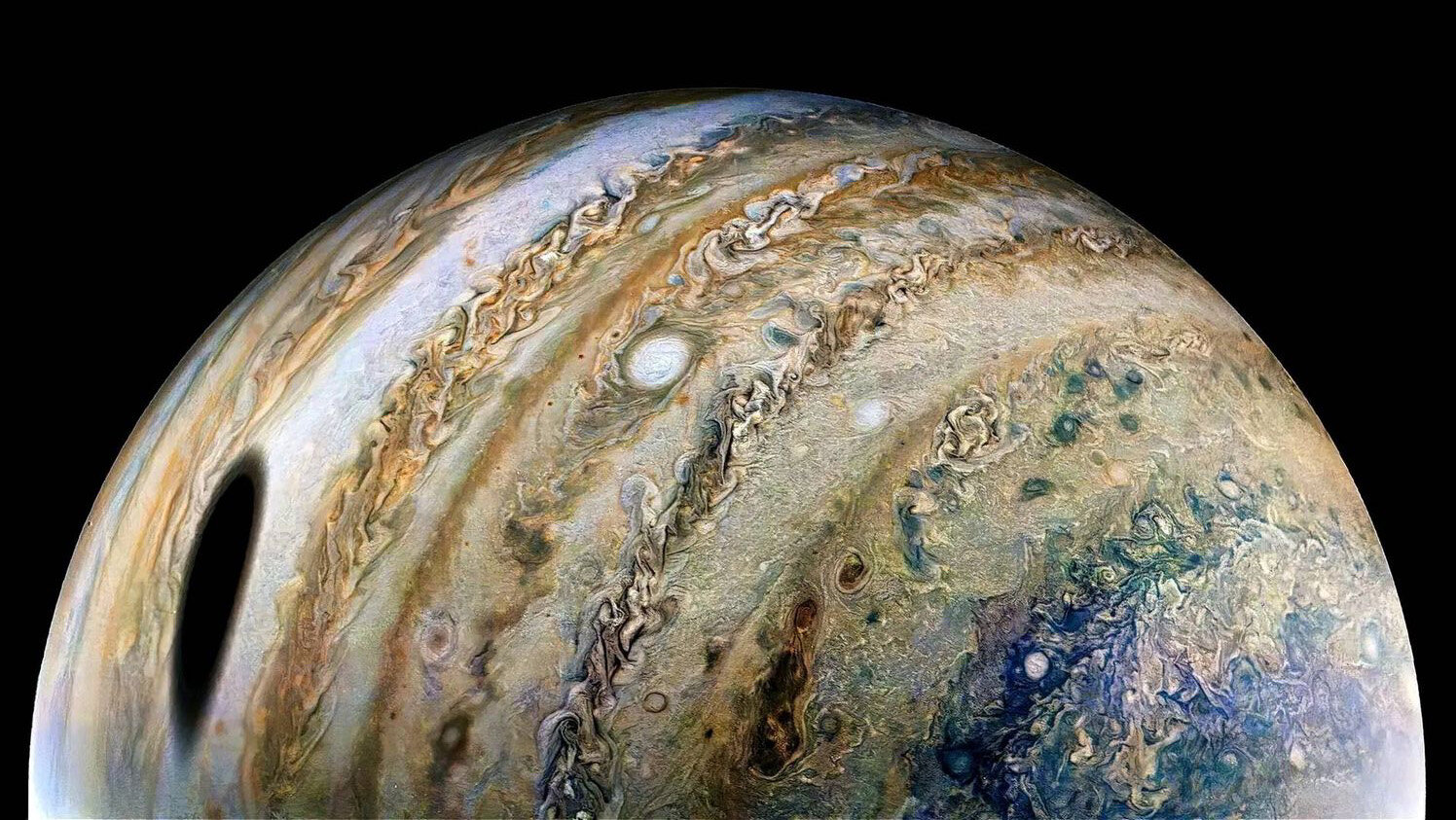
In a groundbreaking exploration, researchers utilize the VLT exoplanet hunter to delve into the mysteries of Jupiter's winds. For the first time, this cutting-edge instrument, designed for interstellar planet discovery, focuses its lens on an object within our solar system, unraveling the enigma of Jupiter's atmospheric dynamics.
Amidst the commonality of discovering exoplanets in distant galaxies, exceeding 5,000 registrations, attention now shifts to the largest planet in our solar system. While extensive data on exoplanet atmospheres is available, fundamental questions about Jupiter's atmospheric intricacies persist. To comprehend the nuances within Jupiter's clouds and air layers, continuous observations over time are imperative.
Researchers from the Institute of Astrophysics and Space Sciences at the University of Lisbon leveraged the ESPRESSO spectrograph on the VLT telescope at the European Southern Observatory to measure wind speeds on Jupiter, marking a historical first. The findings, detailed in the journal Universe, showcase the innovative Doppler velocimetry method, utilizing visible light reflection from the sun by Jupiter's atmospheric clouds.
Previously developed for Venus, this method allows for real-time measurement of instantaneous wind speeds at observed points on Jupiter's surface. Despite challenges, including Jupiter's rapid rotation and gaseous nature, the team successfully measured winds ranging from 60 to 428 km/h with remarkable precision.
This groundbreaking success paves the way for systematic monitoring of distant atmospheres on gaseous planets. The team's focus on Jupiter's equatorial zone and belts yielded valuable insights into the composition of its atmosphere, dominated by ammonia, ammonium hydrosulfide, and water clouds.
The ESPRESSO's effectiveness in measuring winds on Jupiter demonstrates its potential for broader applications. As the team plans to extend observations to cover Jupiter's entire disk and temporal rotation, the methodology's mastery holds promise for studying other gaseous planets, with Saturn as the next target.
This achievement gains significance as the successor to ESPRESSO, ANDES, is in the design phase for the future Extremely Large Telescope (ELT), and the JUICE mission by the European Space Agency is poised to provide additional insights into Jupiter's mysteries. The success of these observations propels us into a new era of understanding our cosmic neighborhood, unlocking Jupiter's hidden secrets and laying the foundation for broader planetary exploration.
More: https://phys.org/news/2023-12-vlt-exoplanet-hunter-jupiter.html