


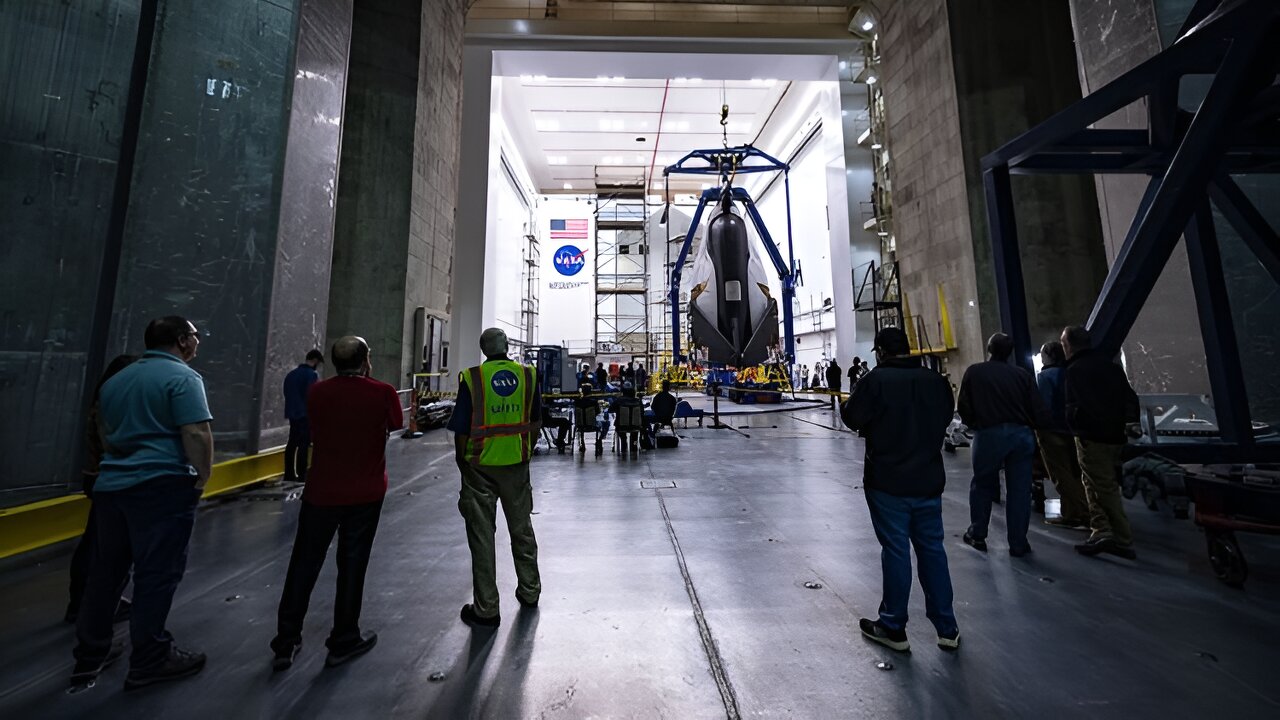
After nearly two decades of relentless pursuit, Sierra Nevada Corporation's Dream Chaser, aptly named "Tenacity," is now undergoing crucial environmental testing at NASA's Neil Armstrong Test Facility in preparation for its historic maiden flight to the International Space Station (ISS) slated for April 2024.
The comprehensive environmental testing assesses Tenacity's resilience to intense launch and re-entry vibrations, as well as the demanding conditions of outer space, encompassing extreme temperature fluctuations and vacuum exposure. This pivotal phase follows Sierra Space's recent announcement of the completion of Tenacity and the delivery of Sierra Space's cargo module, Shooting Star, to the Neil Armstrong Test Facility in Colorado.
Tom Vice, Sierra Space CEO, emphasized the revolutionary nature of their platform, stating, "At Sierra Space, we are ushering in the next industrial revolution with a business and technology platform that provides our customers with a complete turn-key solution offering space as a service."
Dream Chaser's journey, marked by rejections, legal proceedings, and engineering feats, culminated in NASA's selection in January 2016 for cargo delivery to the ISS. Notably, Dream Chaser achieved a significant milestone with a successful free flight test at Edwards AFB in November 2017, a testament to its progress in the commercial space industry.
The primary goal of Dream Chaser is to establish a cost-effective means of delivering cargo and supplies to the ISS. Its unique landing mechanism, resembling an airplane, enhances reusability. NASA has contracted Dream Chaser for a minimum of six cargo resupply missions to the ISS.
The maiden flight, set for 2024, will involve collaboration between the Dream Chaser Mission Control Center in Colorado, NASA's Kennedy Space Center in Florida, and NASA's Johnson Space Center in Texas. During this mission, Tenacity will execute in-flight tests, including vehicle maneuvering demonstrations within the ISS approach ellipsoid.
Unlike other spacecraft, Dream Chaser will use the Canadarm2, a 17-meter robotic arm, for docking and undocking. Tenacity is poised to deliver over 3,500 kilograms to the ISS, remaining docked for approximately 45 days before returning to Earth.
Upon successful completion, Dream Chaser's future flights will enable the delivery of up to 5,200 kilograms of supplies to the ISS, staying docked for an extended 75 days. Additionally, it can return more than 1,600 kilograms of experiments and cargo from the ISS, contributing to a new era in space cargo capabilities.