


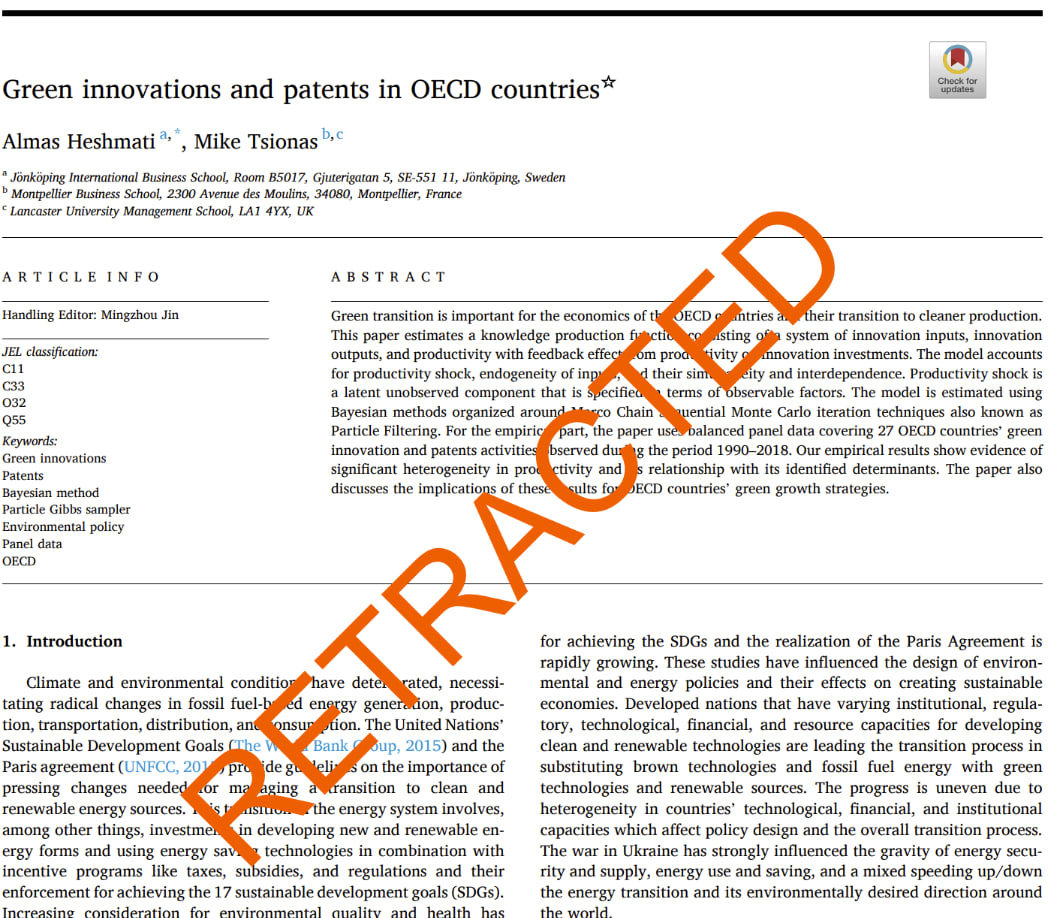
An Elsevier journal has retracted a paper authored by two senior economists after it was discovered that they had replaced significant portions of missing data in their dataset using questionable methods without disclosing the procedure.
The retraction came after a Retraction Watch investigation revealed that Almas Heshmati, the corresponding author of the paper and an economist at Jönköping University in Sweden, had utilized Excel's autofill function and other undisclosed operations to fill thousands of empty cells, constituting over 10% of the dataset.
Gary Smith, an economist, criticized Heshmati and his coauthor for their lack of transparency, stating that they had "no justification" for failing to describe their actions. He emphasized that fabricating data is not an acceptable solution to data absence.
Less than three weeks after the report, Elsevier announced the retraction of the study titled "Green innovations and patents in OECD countries," which was published in the Journal of Cleaner Production last year. The retraction notice cited concerns raised about the data post-publication and acknowledged the author's use of imputation methods without proper disclosure or testing of its effects on the results.
Heshmati's paper, cited twice according to Clarivate’s Web of Science, has been questioned for its validity. Alexander Magazinov, commenting on the retraction, noted discrepancies between the description of imputation methods in the retraction notice and the Retraction Watch report.
This isn't the first time Heshmati has faced scrutiny over his data practices. In a similar case in 2020, a paper he co-authored and published in Empirical Economics relied on the same patched-up dataset without disclosing data gaps or Excel operations.
Springer Nature, the publisher of the Empirical Economics paper, stated they were investigating the matter but has yet to provide an update. Heshmati has not responded to requests for comment on the recent retraction.
