












































































































































































































































































































































































































































































































































































































































Case
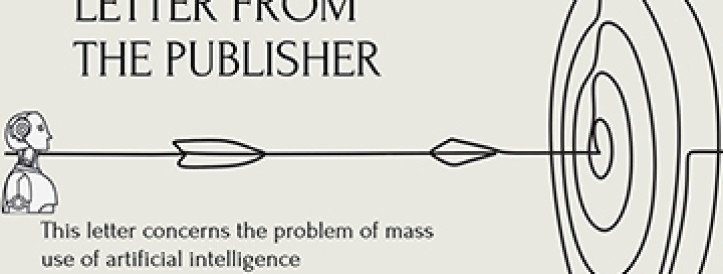
A letter was sent to the magazine with detailed information about the case. The authors were from Japan. After peer review and revision, the case report was accepted and acknowledgment was sent to the authors. Then two anonymous letters were received, both from Japan. Both letters claimed that the author "values honor above all else" and that he had provided "ridiculous data".
The latest issue of the Eastern-European Journal of Enterprise Technologies has been released.
Read more: EEJET | Vol. 5 No. 7 (125) (2023) | Applied mechanics
The latest issue of the Eastern-European Journal of Enterprise Technologies has been released.
Read more: EEJET | Vol. 5 No. 6 (125) (2023) | Technology organic and inorganic substances
The latest issue of the Eastern-European Journal of Enterprise Technologies has been released.
Read more: EEJET | Vol. 5 No. 5 (125) (2023) | Applied physics
The latest issue of the Eastern-European Journal of Enterprise Technologies has been released.
Read more: EEJET | Vol. 5 No. 4 (125) (2023) | Mathematics and Cybernetics - applied aspects
The latest issue of the Eastern-European Journal of Enterprise Technologies has been released.
Read more: EEJET | Vol. 5 No. 3 (125) (2023) | Control processes

In a groundbreaking development, Google has unveiled Assistant with Bard, a cutting-edge personal assistant driven by generative artificial intelligence. This revolutionary technology seamlessly integrates Bard's generative capabilities and logical reasoning with the personalized assistance of the Assistant. Users can engage with this innovative assistant through text, voice, or images, allowing it to perform various actions on their behalf. The accessibility of Assistant with Bard on Android and iOS mobile devices is anticipated in the coming months, as announced on the official Google website.
The latest issue of the Eastern-European Journal of Enterprise Technologies has been released.
Read more: EEJET | Vol. 5 No. 2 (125) (2023) | Information technology. Industry control systems

The Marrakesh Treaty, which was adopted on June 27, 2013, is part of the set of international treaties on copyright, the administrative functions of which are performed by the World Intellectual Property Organization , which is designed to facilitate the access of people with visual impairments and limited perception of printed information to objects protected by copyright.
Read more: A LAWYER CONSULTS. UKRAINE RATIFIED THE MARRAKESH TREATY